
Milan, the metropolis that finds a perfect and dynamic balance between history and modernity, is the regional capital of Lombardy, in northern Italy, and the seat of the Metropolitan City of Milan. It is the second-most populous city in Italy after Rome, with a population of 1,362,863 in 2026. The city's wider metropolitan area is the largest in Italy, and the fourth-largest in the European Union, with an estimated population of 6.55 million. Milan is considered Italy's economic capital, and its metropolitan area accounts for about 20% of the country's GDP. While it is considered one of the world's fashion and design capitals, as well as a financial hub, Milan is also a city of culture and thought. While always looking towards the future, this Lombard capital lovingly preserves its prominent history, boasting spectacular museums and some of the most monumental churches in Italy.
Public Transportation
Getting around Milan is really easy: you can walk to reach the main attractions, but if you need to cover longer distances you can use the extensive public transport network plus various types of rental vehicles and taxis.
The metro, tram and bus network in Milano is operated by ATM - Azienda Trasporti Milanesi.
The city is served by 5 underground lines: M1 Red, M2 Green, M3 Yellow, M4 Blue and M5 Lilac. The numerous bus and tram lines offer a not-to-be-missed opportunity to view the city from a window seat.
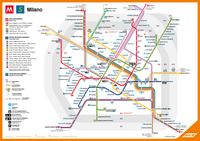
Information about the Milan Metro can be found here:
https://www.milanpublictransport.com/metro-milan/
More info for getting around the city and how to buy tickets can be found here:
https://www.yesmilano.it/en/traveller-information/getting-around
Please find here an excerpt of sights to discover the soul of Italy's fashion capital:
Duomo di Milano

One of the city's most symbolic places is the Cathedral „Duomo di Milano“.
It took six centuries to finish this Cathedral, whose construction started in 1386 by Gian Galeazzo Visconti, Duke of Milan, involving various artists, sculptors and the Milanese themselves, as those who could not pay for the construction offered their labor. The most recent restoration was carried out by the Veneranda Fabbrica. The Cathedral is the largest and most complex Gothic construction in Italy, made of pinkish white marble from Candoglia, the quarry dedicated exclusively to the construction of the Milan Cathedral. On the highest spire stands the golden statue of the Madonnina.
Inside, admire the columns between the five naves: the Cathedral is the only church in the world with capitals decorated with statues; the stained glass windows show biblical scenes, including the Last Judgement; on the floor and behind the counter-façade there is a brass strip, it is the Solar Sundial, made in 1786 by the Brera Astronomical Observatory, and it serves as a clock and zodiac calendar, used to change the measurement of time, passing from the medieval day to the French one.
Taking the elevator, you can go up to the Terraces to look closely at the spires and the Madonnina and to enjoy panoramic views of the city.
Sforzesco Castle
.JPG/picture-200?_=19eab5256ed)
Among the largest castles in Europe and one of the main attractions of Milan and its history, the Castello Sforzesco was built between 1300 and 1400 with a primarily defensive function. Today, it houses the Civic Museums that hosts works by Bellini, Antonello da Messina and Mantegna, but also the Egyptian Museum, the Museum of Ancient Art, the Pietà Rondanini, the famous unfinished sculpture by Michelangelo, the Pinacoteca and the Sala delle Asse by Leonardo da Vinci. Do not miss the majestic grounds within the Castle, split into three courtyards: Piazza d'Armi where the soldiers stayed, the courtyard of the Rocchetta, the most protected section of the castle where the treasure of the duchy was kept, and finally the Ducal Court, characterized by the beautiful garden with a long pool in the middle.
Santa Maria delle Grazie
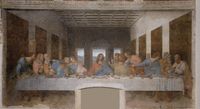
It is one of the greatest testimonies of Renaissance art linked to the name of Leonardo da Vinci: the Church of Santa Maria delle Grazie, in the heart of Milan.
An imposing architectural work of great importance, it is inextricably linked to the Last Supper, a famous painting, and not a fresco as it is commonly called, by Leonardo, preserved inside the place where the Dominicans used to eat. The precious Milanese church, in perfect early Renaissance Lombard style, was inscribed on the UNESCO World Heritage List in 1980 and attracts tourists from all over the world.
La Scala
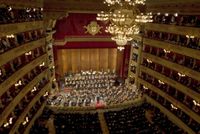
The Milan Opera House, officially Teatro alla Scala, but usually called La Scala for short, is a masterpiece of neoclassical architecture. The current Teatro alla Scala was built to replace an earlier theater destroyed by fire in the 18th century. Milan had long been a center of opera, but first a church had to be demolished to make way for the new opera house. Many famous operas have premiered here, including Verdi's Otello, Puccini's Madama Butterfly, Rossini's La Cenerentola, and Bellini's Norma. Most of Italy's greatest operatic artists, and many of the finest singers from around the world, have appeared at La Scala. The theatre is regarded as being one of the leading opera and ballet theatres globally. It is home to the La Scala Theatre Chorus, La Scala Theatre Ballet, La Scala Theatre Orchestra, and the Filarmonica della Scala orchestra. The theatre also has an associate school, known as the La Scala Theatre Academy, which offers professional training in music, dance, stagecraft, and stage management.
Galleria Vittorio Emanuele II
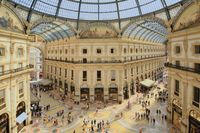
The covered passageway between the Teatro alla Scala and the Duomo of Milan.
Galleria Vittorio Emanuele II is the most famous shopping gallery in Italy. Built in neo-Renaissance style, it is one of the greatest examples of iron architecture in Europe. With its great triumphal arch entrance that stands out majestically next to the Duomo of Milan, it has a cross-shaped plan and the intersection is called the Octagon, with the central dome measuring 47 meters in height. Two-hundred-fifty linear meters where you can find iconic historical stores and those of the most luxurious brands, a 7-star hotel and the Prada Observatory, in a unique historical and architectural context. Do not miss a walk on the roofs, to see Piazza Duomo from above while enjoying an aperitif. And do not forget, as a superstitious gesture, to spin three times on the bull’s groin area, a mosaic on the floor at the center of the Gallery.
Shopping
.jpg/picture-200?_=19eab551faa)
Milano – the city where fashion and luxury set the trends.
Via Monte Napoleone, Via Della Spiga, Via Manzoni and Corso Venezia: these are the streets that make up Milan’s district devoted to luxury shopping and known throughout the world as the High Fashion District. Strolling through this area is an opportunity to admire the shop windows, which become true compositions of taste and design, to visit the most exclusive showrooms and also discover the history of the city thanks to important museums such as Casa Museo Bagatti Valsecchi, Casa Museo Poldi Pezzoli, Casa del Manzoni, Gallerie d'Italia and Palazzo Morando, the museum dedicated to fashion, costume and image.
Navigli
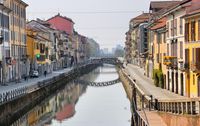
A worthy end of the day is a stroll along the Navigli canals, joining in with night-time mood of the Milanese themselves, among trattorias, restaurants, pubs and bistros.
The Navigli area starts at the Darsena in Porta Ticinese, from which the two waterways branch off. It is the perfect place for experiencing the nightlife of Milan, with trendy clubs, bars and small shops merged in a unique context hosting a mix of modern buildings, Art Nouveau buildings and the famous “railing houses”, typical of Milanese architecture. You can take a stroll on the small bridges that cross the navigable canals as well as through the narrow alleys with large wooden doors. In the evening, a myriad of bars, ethnic restaurants and clubs transform these streets into the ultimate district for aperitifs, music and nightlife.
Even the New York Times loves the Navigli and has included Corso Ripa di Porta Ticinese among the 12 most beautiful streets in Europe for a stroll.
Further information
For further information about sights in Milan please visit the website of the Milan Tourist office:
https://www.yesmilano.it/en/must-see-attractions
https://www.italia.it/en/lombardy/milan/things-to-do/milan-weekend-breaks